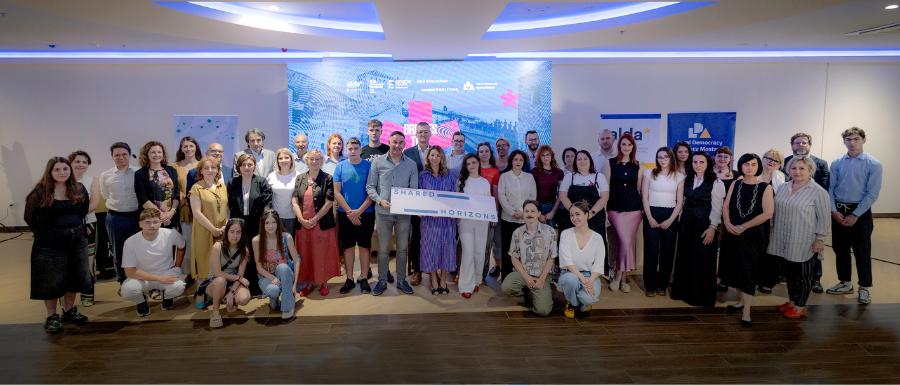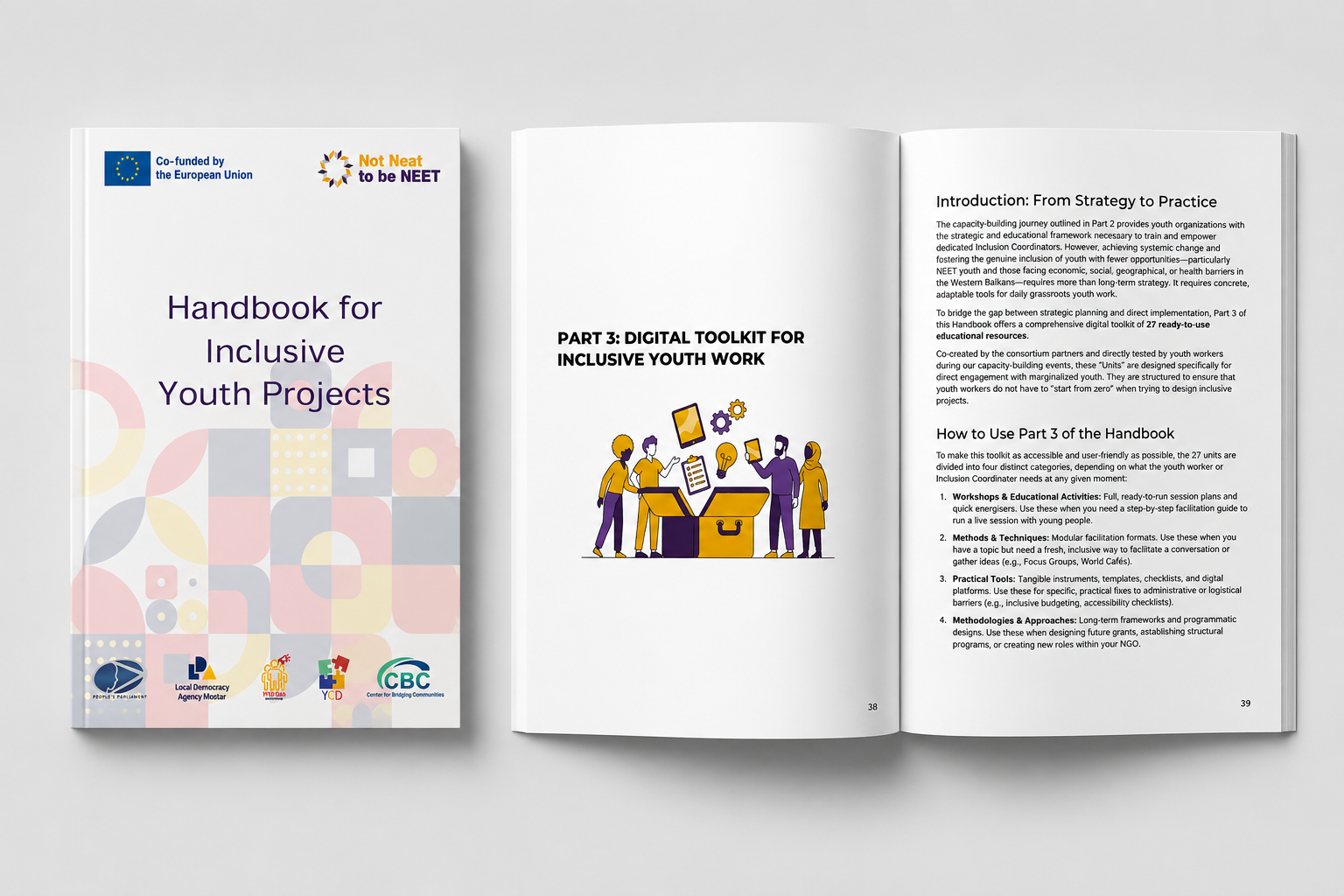
Within the framework of the regional Erasmus+ project “Not Neat to be NEET – Capacity Building of Western Balkan Youth Organizations for More Inclusive Projects and Full Participation of Youth with Fewer Opportunities,” a consortium of partner organizations from the Western Balkans has officially launched the publication “Handbook for Inclusive Youth Projects.” This comprehensive handbook is the result of years of joint work, research, and practical experience of organizations dedicated to youth empowerment and the promotion of social inclusion.
For LDA Mostar, this handbook is not just a project output, but a practical guide through our vision of youth work. Our goal was clear: to translate methodology into concrete tools that will make the daily struggle for a more inclusive society easier for youth workers on the ground.
From European Strategies to Grassroots Realities
The main innovation of this handbook lies in the introduction and professionalization of a completely new role in the youth sector: the Inclusion Coordinator. In order for the priorities of European standards to truly come alive on the ground—both in our region and anywhere else in Europe—we must start with the basics. The position of marginalized youth and the NEET population will not change through dry promises. Change happens only when youth organizations gain professionals who are trained according to the highest European standards, dedicated, and ready to extend a helping hand to every young person. This is why the handbook was designed as a universal model, providing a methodology that is equally applicable and functional in the Western Balkans as it is in any youth center across the European Union.
The handbook is explicitly designed to equip civil society organizations and youth workers, ensuring that no one has to start from scratch when creating inclusive methodologies. Through a “learning by doing” approach, the handbook offers concrete guidelines for overcoming real-world obstacles—whether it involves including a young person with health difficulties, a participant who does not speak English, or a young person who cannot afford the costs of international travel.
Three Steps to More Inclusive Projects
To make navigation and practical application as simple as possible, the publication is divided into three main sections:
-
Part 1: Regional Research: Provides a detailed overview of the socio-economic realities and structural barriers faced by marginalized youth across the Western Balkans, based on focus groups and field consultations.
-
Part 2: Non-Formal Education Methodology: Outlines the capacity-building process for Inclusion Coordinators through five interconnected phases, including online and national training sessions, mentorship, and a pioneering local job shadowing model.
-
Part 3: Practical Digital Toolkit with 27 Educational Units: The core of the handbook consists of 27 ready-to-use workshops, methods, and tools for inclusive youth work. These resources cover everything from inclusive budgeting and community need-mapping techniques to modern methods such as Forum Theater, the Living Library method, the World Café approach, and the local Job Shadowing program.
A special place in the handbook is reserved for our local job shadowing model. We have proven that youth workers can learn through practice and improve in the real-world working environment of other organizations without the need for expensive travel and international budgets. This approach demonstrates that top-tier education can be sustainable, affordable, and, most importantly, directly linked to the actual challenges in our local communities.
Case Studies: A Story Connecting Expertise and Pure Humanity
The best proof that this model does not remain just a theory on the pages of a handbook is a real story from the field—the transformative experience of Jelena Mihić at the Mostar-based association “Plava vrpca” (Blue Ribbon). For Jelena, participating in the Job Shadowing program was not just professional development, but a deeply personal and transformative experience. Although she entered the program with the goal of learning how inclusive activities are planned and implemented in a real environment, she gained much more—she became an integral part of the team changing the perception of autism in Mostar.
“My practice was not just ‘job shadowing’; it was an intensive school of humanity. As a psychologist, I often asked myself: What happens to youth on the spectrum after the death of their parents or caregivers? This difficult question, which arose during my first week, became the driving force behind my search for meaning in this work. I realized that our role is not just to support the child today, but to build a system and a community that will be their safe harbor tomorrow. Seeing how the world becomes a richer place when we allow differences to connect us, I saw the core of pedagogy in practice.”
The President of the “Plava vrpca” association, Igor Antunović, emphasized that Jelena quickly became an important part of their team through her sincere desire to help, and readily responded to all organizational challenges during the period.
“Through our project ‘Enter My World,’ which promotes inclusion, Jelena got directly acquainted with the work of the association and, together with other members, participated in daily activities and the coordination of this project. A special focus was placed on understanding how inclusive activities are planned and implemented in a real environment. With her approach, responsibility, and sincere desire to help, Jelena very quickly became an important part of our team and our daily life.”
It is important to highlight that one of the greatest values of this Handbook is its cross-border scalability. Although developed and tested in the specific context of the Western Balkans, its practical tools are universally adaptable and can be freely used by youth organizations across Europe.
A clear vision runs through the entire publication: inclusion must not be just an additional activity or a formal, administrative project requirement. It is the fundamental principle underpinning high-quality programs, where youth with fewer opportunities are not viewed as passive beneficiaries of aid, but as equal participants and drivers of positive change in their communities.
The “Handbook for Inclusive Youth Projects” is currently available in English.
Looking to the Future: A Regional Network as Permanent Infrastructure
All of these processes—from minor and major changes in local communities, through regional training, to the creation of the handbook—are part of a much broader regional story.
At the recent international training “Inclusion Coordinators Across Borders – Training and Networking for Youth Workers and Educators” held on Kopaonik, youth workers translated their practical and methodological work into a permanent platform by establishing the regional network “Inclusion Coordinators Across Borders.” This network ensures that cooperation does not end with the conclusion of individual project activities. Instead, it becomes a permanent regional infrastructure that will enable youth workers to jointly implement the tools from the new handbook, continuously exchange best practices, and advocate systematically toward institutions.
 Co-funded by the European Union. Views and opinions expressed are however those of the author(s) only and do not necessarily reflect those of the European Union or the European Education and Culture Executive Agency (EACEA). Neither the European Union nor the EACEA can be held responsible for them.